
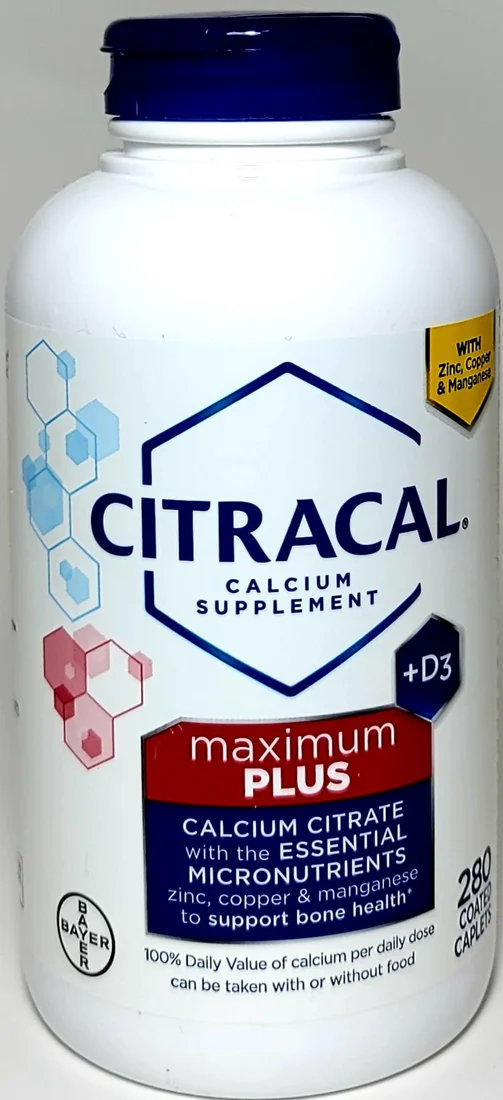
Calcium citrate is one of the more established, unglamorous choices in the calcium aisle, and Citracal Maximum Plus is one of the more established, unglamorous bottles you'll find carrying it. It's made by Bayer, it's sold at most major pharmacies and on Amazon, and it doesn't promise anything dramatic — just a way to help fill the gap between what your diet provides and what your bones use every day. That ordinariness is actually the point of this review: we wanted to look at a product people already reach for, and be straightforward about what the label really says.
- Form: Calcium citrate, coated caplets
- Per serving (2 caplets): 630 mg calcium (as calcium citrate) + 1,000 IU (25 mcg) vitamin D3
- Also contains: Zinc, copper, and manganese
- Label directions: One serving (2 caplets) twice daily, with or without food, or as directed by a healthcare provider
- Sizes sold: 120, 180, and 280 caplets per bottle
- Made by: Bayer
What's Actually in Each Serving
Per the current label, one serving — two coated caplets — provides 630 mg of calcium (as calcium citrate) and 1,000 IU of vitamin D3, along with small amounts of zinc, copper, and manganese. Citracal's own packaging and directions call for taking one serving twice a day, which works out to four caplets and roughly 1,260 mg of calcium citrate and 2,000 IU of vitamin D3 across a full day if someone takes both servings — though how much of that a given person actually needs depends on diet, age, and what a doctor recommends, so the label directions are a starting point, not a one-size-fits-all number.
We didn't find a current USP Verified mark on this product, so we're not claiming one. The label doesn't list any gluten-containing ingredients, but that's different from a certified gluten-free claim, and we're being careful not to blur the two.
Why Calcium Citrate Specifically
The main practical difference between calcium citrate and the cheaper, more common calcium carbonate is absorption chemistry: citrate doesn't need stomach acid to be absorbed, while carbonate does. That's a well-documented, general nutrition fact (not specific to this brand), and it's the reason citrate forms are often mentioned as a reasonable option for people who take acid-reducing medication or who've noticed carbonate sits heavier on their stomach. It's also why the label can honestly say it can be taken with or without food. None of that makes it a treatment for anything — it's just a description of how this particular form of calcium behaves in the body.
Who This Tends to Fit
This is a reasonable, unremarkable option for an adult who wants a citrate-form calcium supplement with D3 built in and isn't looking for anything more elaborate than that. It fits people who've had trouble with calcium carbonate, people on medication that reduces stomach acid, and people who'd rather take a well-known pharmacy brand than sort through less familiar labels.
It's worth saying plainly: this is a general nutritional supplement, not a treatment for osteoporosis or any other diagnosed bone condition. If you've already been diagnosed with low bone density, this product is not a substitute for whatever plan your doctor has you on — it's the kind of everyday supplement you'd discuss with them as one small piece of the picture, not the piece.
A Few Honest Trade-offs
- The caplets are on the larger side, though several reviewers on retailer sites mention a score line for splitting them if swallowing whole caplets is difficult.
- Twice-daily dosing means remembering a second serving later in the day — a once-daily D3-only pill is simpler, if less complete.
- It's a recognizable pharmacy brand, which generally means a higher price per serving than a plain generic calcium citrate + D3 store brand with a similar supplement facts panel.
- It does not contain vitamin K. If a vitamin K2 combination specifically is what you're after, this isn't that product — it's calcium citrate, vitamin D3, zinc, copper, and manganese, and nothing more.
Calcium supplements can interact with the timing of certain medications — thyroid medication and some antibiotics are common examples, and calcium can also affect how bisphosphonate osteoporosis medications are absorbed if taken too close together. None of that is a reason for alarm; it's a reason to mention any new supplement to your doctor or pharmacist and ask about timing, especially if you take other daily medications.
Where to Buy
Citracal Maximum Plus is sold in 120-, 180-, and 280-caplet bottles through Amazon and most major pharmacies. Pricing moves around, so rather than quote a number that will go stale, we'd rather send you to check the current listing directly.
As an Amazon Associate, Aging Well Post earns from qualifying purchases. The NIH link above is a citation, not an affiliate link — see our Affiliate Disclosure for how that distinction works.
Citracal is a registered trademark of Bayer. Aging Well Post is not affiliated with or endorsed by Bayer; this is an independent review. Nothing on this page is intended to diagnose, treat, cure, or prevent any disease, including osteoporosis. Talk to a healthcare provider before starting any new supplement, especially alongside existing medications.
Sources: Citracal Maximum Plus product labeling and retailer listings (Amazon, Walmart), current as of September 2026. National Institutes of Health, Office of Dietary Supplements — Calcium: Fact Sheet for Health Professionals.