
Centrum Silver Adults 50+: What Actually Changes in the Formula After 50
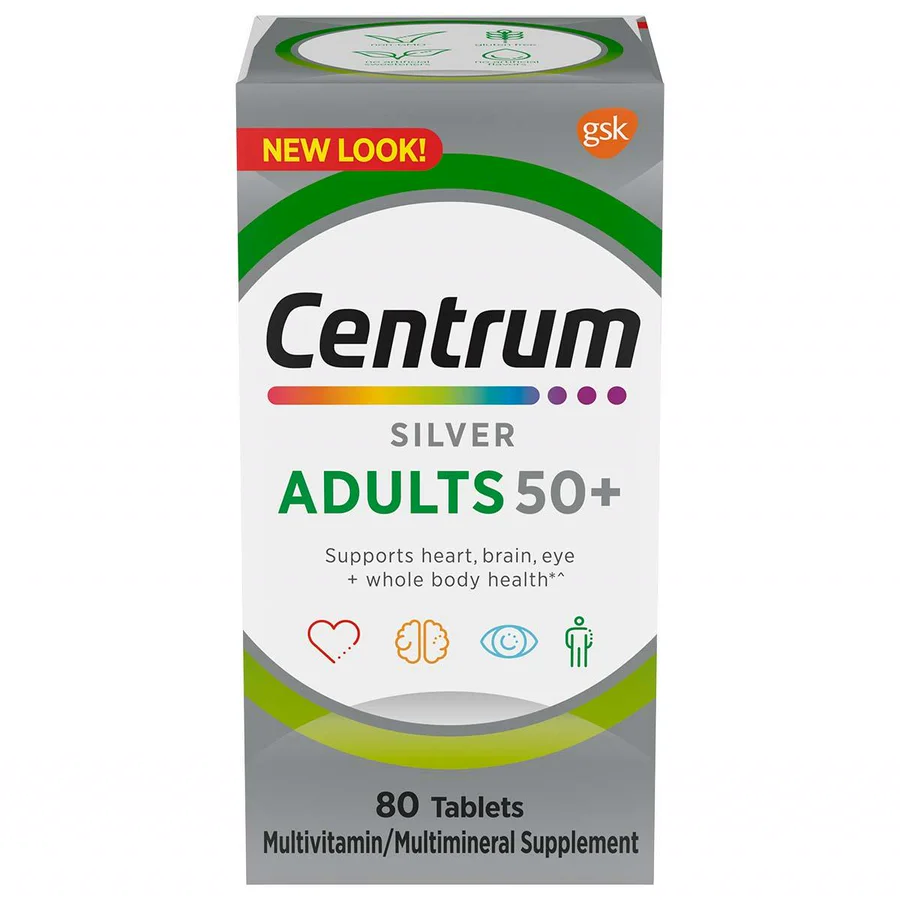
Centrum Silver has been the best-selling age-50-plus multivitamin on U.S. shelves for years, and it's easy to assume "Silver" is mostly a marketing label slapped on the same tablet. It isn't. Pulling the manufacturer's own current label shows a formula that's genuinely reworked for an older body — some nutrients removed entirely, others raised well past where a standard adult formula sits. We went through that label line by line, then checked the cognition research the brand now leans on heavily in its marketing, and what it does and doesn't show.
- No iron. The 50+ formula contains zero iron — a deliberate omission, not an oversight.
- Vitamin B12 at 417% of the Daily Value (25 mcg), well above a typical adult formula, to help offset age-related declines in B12 absorption.
- Vitamin D at 250% DV (1,000 IU) paired with 220 mg of calcium, aimed at bone density support.
- Real, NIH-funded cognition research exists behind this specific product (the COSMOS trials) — with a genuinely modest, honestly-caveated effect, not a "clinically proven memory fix."
- Verified gluten-free and non-GMO ingredients — but no USP Verified Mark or other independent third-party testing certification on this product.
What It Is
Centrum Silver Adults 50+ is a once-daily tablet multivitamin/multimineral supplement, sold in Amazon, pharmacy, and grocery listings typically running 65 to 325 tablets per bottle. The Centrum brand itself dates back decades and was originally a Wyeth product before Pfizer acquired it in 2009; since 2022, the consumer-health business that markets Centrum operates as Haleon, the company GSK and Pfizer spun off from their combined consumer healthcare joint venture. Centrum's own official product labeling (filed under Pfizer, which retains the "Marketed by" line on the current label document) lists a manufacturing address of Madison, NJ, and directs product questions to Centrum's own consumer line — a traceable, accountable company, which is more than we can say for a lot of the newer direct-to-consumer supplement brands we cover.
What Actually Changes at 50: The Real Label Differences
The "Silver" reformulation isn't cosmetic. Every number below is taken directly from the current official Supplement Facts panel Centrum's manufacturer files for this product:
| Nutrient | Amount | % Daily Value |
|---|---|---|
| Vitamin A | 2,500 IU (40% as beta-carotene) | 50% |
| Vitamin D | 1,000 IU | 250% |
| Vitamin B12 | 25 mcg | 417% |
| Calcium | 220 mg | 22% |
| Zinc | 11 mg | 73% |
| Iron | Not present | 0% |
Iron is gone. A standard adult multivitamin is typically built assuming some users are still menstruating and need iron replacement. Past roughly age 50, most adults no longer have that requirement, and unneeded iron doesn't just pass through harmlessly — it can accumulate in the body over years of daily supplementation. Removing it is a genuine, sensible age-specific adjustment, not a cost-cutting shortcut.
B12 is raised sharply — 417% of the Daily Value in one tablet. This tracks a real, well-documented pattern: a meaningful share of older adults produce less stomach acid over time, and stomach acid is what's needed to free B12 from food. The crystalline B12 used in a supplement tablet doesn't require that same digestive step, so a higher dose is a reasonable way to help close a gap that's more common with age — not a sign the vitamin is being oversold.
Vitamin D and calcium are both present at levels aimed at bone density — 250% DV of vitamin D alongside 220 mg of calcium — reflecting that bone density loss accelerates with age for both men and postmenopausal women.
Vitamin A is deliberately capped lower, with a printed warning. At 50% DV, with 40% of that already coming from beta-carotene (a form the body regulates safely on its own), the preformed vitamin A dose is modest. Centrum's own label states this directly: "Long-term intake of high levels of vitamin A (excluding that sourced from beta-carotene) may increase the risk of osteoporosis in adults. Do not take this product if taking other vitamin A supplements." That's the manufacturer itself flagging a real, age-relevant bone-health risk on its own packaging — worth knowing if you're also taking a separate vitamin A or fish-liver-oil supplement.
The formula also includes 250 mcg of lutein and 300 mcg of lycopene (both without an established Daily Value), consistent with Centrum's marketing claim of eye-health support, alongside a full B-vitamin complex, iodine, magnesium, zinc, selenium, and a set of trace minerals.
The Cognition Research: What COSMOS Actually Found
Centrum now markets Silver heavily around brain health, and unusually for this category, there's real, independently-published, NIH-funded research specifically behind this product rather than behind "multivitamins in general." It comes from three related trials run under the COSMOS umbrella (the COcoa Supplement and Multivitamin Outcomes Study), each using this exact Centrum Silver formula against a matching placebo:
COSMOS-Mind (Wake Forest University, published in Alzheimer's & Dementia, 2022) followed 2,262 adults 65 and older for three years and found daily multivitamin use improved global cognition, episodic memory, and executive function compared with placebo, with the benefit appearing larger in participants who had cardiovascular disease. COSMOS-Web (Columbia University, published in the American Journal of Clinical Nutrition, 2023) followed a larger group of 3,562 older adults using annual online cognitive testing over three years and found a significant improvement specifically in episodic memory. A third, smaller in-person study, COSMOS-Clinic (573 participants), found a more modest overall cognitive benefit — a significant improvement in episodic memory, but notably not in executive function or attention, an honest inconsistency the researchers themselves reported rather than smoothed over.
Pooling all three studies — more than 5,000 non-overlapping older adults in total — the research team's published estimate was that daily multivitamin use was associated with global cognitive aging that was slower by the equivalent of about two years compared with placebo. That's a real, meaningful, and honestly modest population-level finding — not a claim that any one person will notice a two-year difference, and not evidence the multivitamin treats or prevents any diagnosed cognitive condition.
The funding is worth being precise about, both ways. COSMOS was funded primarily by National Institutes of Health grants (National Institute on Aging and other institutes). Pfizer Consumer Healthcare (now Haleon) donated the study's Centrum Silver tablets and matching placebo, and Mars Edge donated the cocoa-extract arm's capsules and placebo — standard practice for large nutrition trials, where a manufacturer supplies product but doesn't run the study. The published disclosure states neither company had input into the data analysis, interpretation, or manuscript. We think that's a genuinely fair arrangement, and we'd say so about any product — but it's also exactly why it's worth naming plainly rather than either hiding it or pretending it doesn't matter.
One more honest caveat: none of the three studies were designed to isolate which specific nutrient in the multivitamin (if any single one) drives the effect, and the researchers themselves have said the underlying mechanism still isn't well understood. Filling a real nutritional gap in someone who has one is the most likely explanation on the table — which also means the effect may be smaller, or absent, in someone whose diet already meets these needs.
Certifications, Precisely
Centrum states Silver Adults 50+ uses verified gluten-free and non-GMO ingredients, and we found nothing to contradict that across the brand's own product pages and major retailer listings. We did not find a USP Verified Mark on this product, nor any claim of independent third-party potency or purity testing (the kind a certification like USP Verified or NSF Certified for Sport would represent). That's common for a mainstream drugstore multivitamin manufactured by a large, publicly accountable company under FDA dietary-supplement manufacturing rules — it is a real, checkable gap worth naming, not a reason for alarm, and it isn't the same category of concern as the untraceable-manufacturer problems we flag on some newer supplement brands.
Who This Is — and Isn't — For
Reasonable to consider if: you're over 50, want a well-studied, no-iron formula from a large and traceable manufacturer, and are looking to cover common age-related gaps in B12, vitamin D, and calcium rather than treat a diagnosed condition.
Worth a conversation with a doctor first if: you take a blood thinner (vitamin K can interact with some anticoagulant medications); you already take a separate vitamin A or fish-liver-oil supplement (see the label's own osteoporosis-risk warning above); you have a kidney condition that requires monitoring mineral intake; or you have a diagnosed iron-overload condition, in which case the absence of iron here is actually a point in this product's favor rather than a drawback. As with any supplement, pregnant or nursing readers should check with a healthcare provider before starting it.
This links to Centrum's own official Amazon listing for the Silver Adults 50+ formula — not a substitute or a different product.
See Centrum Silver Adults 50+ on AmazonThese statements have not been evaluated by the FDA. This product is not intended to diagnose, treat, cure, or prevent any disease. Talk to a healthcare provider before starting any new supplement, especially if you take prescription medication or have a diagnosed medical condition. As an Amazon Associate, Aging Well Post earns from qualifying purchases — see our Affiliate Disclosure for how that works and how it's kept separate from what we choose to cover.
Sources: Centrum Silver Adults official label filing, labeling.pfizer.com (Pfizer Consumer Healthcare / Haleon), document LBL-00000554. · Baker LD, Manson JE, Rapp SR, et al. "Effects of cocoa extract and a multivitamin on cognitive function: A randomized clinical trial" (COSMOS-Mind), Alzheimer's & Dementia, 2022. · Yeung LK, et al. "Multivitamin Supplementation Improves Memory in Older Adults: A Randomized Clinical Trial" (COSMOS-Web), American Journal of Clinical Nutrition, 2023. · "Effect of multivitamin-mineral supplementation versus placebo on cognitive function: results from the clinic subcohort of COSMOS and meta-analysis of 3 cognitive studies within COSMOS" (COSMOS-Clinic), American Journal of Clinical Nutrition, 2024. · Centrum.com official product and ingredient pages. · NIH Office of Dietary Supplements, Dietary Supplement Label Database.