
Everyday Memory Habits After 50 — and What the “Memory Trick” Ads Leave Out

Most of us past 50 know the moment: a name that won't surface, or a reason for walking into the kitchen that vanishes on arrival. Lately an ad tends to follow it — a video styled like a news report, a “forgotten remedy,” a price that's only good today. This guide covers both: the ordinary habits research connects to steadier memory after 50, and why the “memory trick” in your feed doesn't hold up once you read past the headline.
First, What Ordinary Forgetfulness Looks Like
The National Institute on Aging (NIA) is reassuring: taking longer to learn something new, occasionally misplacing the glasses, and recalling a word more slowly are usually ordinary age-related forgetfulness. What NIA says belongs at a doctor's visit is different in kind — asking the same question repeatedly, getting lost in familiar places, or struggling with a recipe or directions you once handled easily.
Just as useful is NIA's list of often-fixable causes of memory trouble: side effects from medicines (some allergy pills, sleep aids, muscle relaxants, and bladder medicines are named), thyroid, kidney, or liver problems, low mood, alcohol, poor sleep, not eating enough, and low levels of nutrients such as vitamin B12. The ads skip that list entirely.
Six Everyday Habits With Real Research Behind Them
1. Move most days
Physical activity has the most consistent evidence. NIA cites a randomized trial in which regular exercise increased the size of a brain structure central to forming memories, and the Finnish FINGER trial is worth knowing by name: 1,260 adults aged 60 to 77 at elevated risk spent two years either in a combined program of exercise, diet coaching, mental training, and vascular check-ups, or receiving general health advice. The combined group finished with modestly but measurably better scores on a battery of thinking tests; the main side effect was sore muscles. A brisk 20-to-30-minute walk most days, plus a couple of short strength sessions a week, is the version most people can keep up.
2. Treat sleep as part of the routine
NIA's advice is plain: older adults need about seven to nine hours, and sleep problems are worth raising with a doctor rather than pushing through them, since poor sleep is on that list of fixable causes. Sleep genuinely changes after 50 — lighter, more fragmented, earlier — and we have a separate guide to what changes and what helps. In short: a fixed wake-up time, morning daylight, and less late-evening alcohol do more than most people expect. Loud snoring or waking up gasping deserves its own mention at your next visit.
3. Get your hearing checked
About one-third of older adults have hearing loss, according to NIA, and untreated hearing problems tend to worsen. The 2024 Lancet standing Commission report on late-life brain health lists hearing loss among 14 modifiable risk factors — with high blood pressure, inactivity, social isolation, smoking, heavy drinking, untreated vision loss, and high LDL cholesterol — and estimates that, in theory, nearly half of dementia cases worldwide could be prevented or delayed by addressing them — a population-level estimate, not a promise for any one person.
The honest caveat comes from ACHIEVE, the largest trial to test hearing care directly: 977 adults aged 70 to 84 with untreated hearing loss received either hearing aids plus audiology counseling or one-on-one sessions with a health educator, and were followed for three years. Across the whole group, thinking scores declined at the same rate either way. But a prespecified analysis found the effect differed by recruitment source: among participants drawn from a long-running heart-health study — older, with more risk factors — decline appeared slower with hearing care. The researchers' reading: hearing care may help most for people already at higher risk. A hearing test is low-risk and improves conversation regardless.
4. Keep people in your week
NIA points to a trial of almost 200 adults aged 75 and older whose early results suggested regular conversational internet calls could help lower the risk of cognitive decline and isolation, and to an analysis of more than 7,000 adults aged 65 and older in the Health and Retirement Study, where higher social engagement went with better thinking and memory. The activity matters less than the regularity: a standing lunch, a weekly call, a volunteer shift, a choir.
5. Know your blood pressure numbers
Decades of observational studies tie high blood pressure in midlife to memory trouble later, NIA notes, and in the large SPRINT MIND trial, adults aged 50 and older who brought systolic pressure below 120 had a lower rate of early thinking and memory problems over about five years. High blood pressure usually has no symptoms you can feel, so NIA recommends yearly screening. A validated home cuff turns an abstract risk into a number you can act on.
6. Nutrition basics, not magic foods
NIA's dietary advice is deliberately unexciting: fruits and vegetables, whole grains, lean protein and fish, low-fat dairy, and less solid fat, sugar, and salt. It acknowledges that evidence for brain-specific patterns such as the Mediterranean and MIND diets is mixed — promising in observational studies, weaker when tested on their own; our earlier guide to everyday habits that support memory goes deeper on that research.
One nutrition fact is specific to this age group. NIA notes that some people over 50 have trouble absorbing the vitamin B12 found naturally in food and may need fortified foods or a supplement to meet the daily recommendation of 2.4 micrograms. MedlinePlus lists people over 50 first among those most likely to run low, with vegetarians and vegans and anyone who has had stomach or intestinal surgery. Low B12 is on NIA's list of fixable causes of memory trouble, and a blood test tells you whether it applies to you.
Notice how many of these cost nothing: a walk, a bedtime, a phone call, a hearing test, a blood-pressure reading. Pick one habit that fits a week you already have, give it a month, then add a second.
What the “Memory Trick” Ads Promise
The ads follow a script so consistent that consumer-protection groups describe it as one pattern. A video styled like a news segment opens with a well-known face and voice that, on inspection, were generated by AI — the real people never said any of it, as fact-checkers and the Better Business Bureau have documented repeatedly. It introduces an “ancient” kitchen remedy, usually honey plus a spice, framed as something experts don't want you to know. Then the pivot: the remedy is “now available” as a capsule, with “limited time” pricing, a warning that stock is running out, bundles of three or six bottles at roughly $49 to $79 each, a 60-day guarantee, bonus e-books, badges implying government approval, and a five-star rating from tens of thousands of reviews you cannot open.
We read the labels on three “official” storefronts for one of the most heavily advertised of these capsules on October 7, 2026. The capsule contains no honey at all. Its ingredients are two amino acids common in circulation and workout supplements, niacin, a token amount of calcium, and beta-alanine, at amounts one storefront's own comparison table concedes are a fraction of what circulation research uses. The seller's FAQ states the finished formula has not been independently tested in clinical trials, carries interaction warnings for blood-pressure medicines and nitrates, and on one storefront asserts a government approval no supplement can truthfully claim, since supplements aren't approved by any agency before sale. The storefronts didn't even agree on the ingredient count, or on the review count (44,628 on one, 36,628 on another). The Better Business Bureau warns that buyers of these “brain honey” products may be auto-enrolled in recurring subscription charges.
Why the Claims Don't Follow
Set the sales tactics aside and look at the ingredients these products lean on.
- Ginkgo. The GEM trial gave 3,069 adults aged 75 and older 120 mg of ginkgo extract twice a day or a placebo for a median of six years. The ginkgo group did no better — slightly more developed serious memory decline, a difference that wasn't statistically significant. One of the largest supplement trials ever run in older adults came back negative.
- Omega-3 capsules. A 2012 Cochrane review of three high-quality trials (3,536 cognitively healthy adults aged 60 and up with follow-up data) gave omega-3 in capsules or, in one trial, an enriched spread for six to 40 months: memory and thinking scores matched placebo. NIH's clinical digest adds that the most consistent encouraging omega-3 findings tend to be measured by how much fish people eat, not by capsules.
- B vitamins for everyone. A 2018 Cochrane review of 14 trials and 27,882 participants, mostly in their 60s and 70s, concluded that B12, B6, and folic acid supplements probably have little or no effect on overall thinking in cognitively healthy adults. The well-known positive trial, VITACOG, involved a specific group: adults over 70 who already had mild memory impairment. Among the 168 who completed brain scans, two years of high-dose B vitamins slowed the rate of brain shrinkage, with the clearest effect in those whose blood homocysteine was high at the start. That's a targeted use to decide with a doctor, not a bottle for everyone.
- The bottom line from NIH. NIA states that no vitamin or supplement is currently recommended for preventing cognitive decline, and NCCIH's digest says direct evidence for supplements is lacking. NIA does mention recent trials in which a daily multivitamin modestly improved memory scores in older adults — a small, still-studied effect from a plain multivitamin, not a secret formula. A capsule also can't do the hearing test, take the walk, or make the call.
A famous person “revealing” a secret fix in a video you've never seen on actual news. A secret ingredient that isn't on the label. A “limited time” price or a warning that stock is running out. A badge or FAQ implying government approval. A refund promise from a company whose name, address, and phone number aren't on the page. Any one of these is a reason to close the tab.
Is Any Supplement Worth Buying? One Honest Answer
For most readers, the truthful answer is “probably not for memory.” The one exception we're comfortable naming comes from the nutrition section: plain vitamin B12. Not because it sharpens memory in people who have enough — the Cochrane evidence says it doesn't — but because absorption from food drops for a meaningful share of people after 50, running low is a recognized and fixable cause of memory trouble, and the fix is cheap and boring. Ask your doctor to check your level. If it's low, or you eat little or no animal food, a basic B12 tablet from an established brand is a sensible routine item. If it's normal, extra B12 is not a memory booster.
 Established Brand · Nutrition Basic
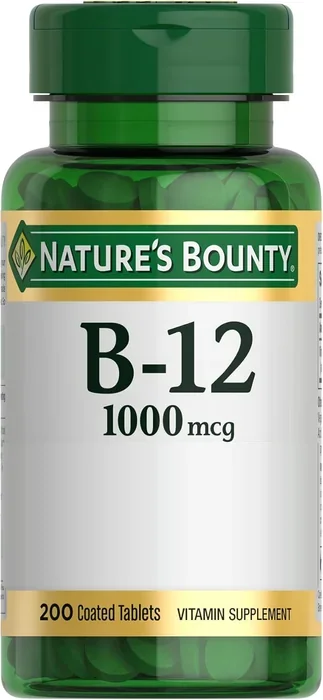
Nature's Bounty Vitamin B-12, 1,000 mcg
200 coated tablets · one tablet daily with a meal · B12 as cyanocobalamin · label states free of sugar and gluten, non-GMO · about $9.97 for a 200-day supply, sold and shipped by Amazon.com, as seen October 7, 2026
Check Current Price on AmazonPlain link: Nature's Bounty Vitamin B-12 1000 mcg, 200 tablets, on Amazon.com. As an Amazon Associate, Aging Well Post earns from qualifying purchases.
Label facts from the manufacturer's page: each tablet supplies 1,000 micrograms, a large multiple of the daily recommendation — normal for B12 products, since only a small fraction of a large oral dose is absorbed; your doctor may suggest a different strength or form. The listing was marked non-returnable for food-safety reasons when we checked. If omega-3s are what you were wondering about, our review of Nature's Bounty Fish Oil explains why we treat it as a heart-health habit, not a memory product.
Bringing It Together
The whole plan fits on an index card: walk most days, keep a fixed wake-up time, get your hearing and blood pressure checked, keep a standing commitment or two with other people, eat the boring balanced diet, and ask about a B12 test at your next visit. Less exciting than a secret recipe — and it's what the trials support. Every item can start this week without typing in a card number.
General information only, not medical advice, and not intended to diagnose, treat, cure, or prevent any disease. Memory changes that worry you deserve a real evaluation, since several causes are treatable. Check with a healthcare provider before adding any supplement, particularly if you take medication. Amazon prices, sellers, and stock change; the figures above are as seen on October 7, 2026.
Sources (all opened for this article):
- National Institute on Aging — Memory Problems, Forgetfulness, and Aging — read the page
- National Institute on Aging — Cognitive Health and Older Adults (SPRINT MIND, ACTIVE, I-CONECT, and Health and Retirement Study findings) — read the page
- National Institute on Aging — Hearing Loss: A Common Problem for Older Adults — read the page
- National Institute on Aging — Vitamins and Minerals for Older Adults (vitamin B12 entry) — read the page
- MedlinePlus (National Library of Medicine) — Vitamin B12 — read the page
- National Center for Complementary and Integrative Health — Clinical Digest on dietary supplements and cognitive function, July 2022 — read the digest
- ACHIEVE hearing-intervention randomized trial in 977 older adults, The Lancet, 2023 — PubMed record
- FINGER two-year multidomain randomized trial in 1,260 at-risk older adults, The Lancet, 2015 — PubMed record
- GEM randomized trial of ginkgo biloba extract in 3,069 adults aged 75 and older, JAMA, 2008 — PubMed record
- Cochrane review of omega-3 supplements and cognitive function in older adults, 2012 — PubMed record
- Cochrane review of vitamin and mineral supplements for maintaining cognitive function in healthy mid- and late-life adults, 2018 — PubMed record
- VITACOG randomized trial of homocysteine-lowering B vitamins and brain atrophy, PLoS One, 2010 — PubMed record
- Livingston G et al., 2024 report of the Lancet standing Commission (prevention, intervention, and care), The Lancet, 2024 — PubMed record
- Better Business Bureau scam alert on AI-generated “brain honey” ads, reported by WBBM Newsradio, 2026 — read the report
- Nature's Bounty — official product page for Vitamin B-12 1,000 mcg, 200 tablets (label facts) — read the page